Hello Pre School
A Designer’s First Look: Friendly, Playful — But Does It Stitch Clean?
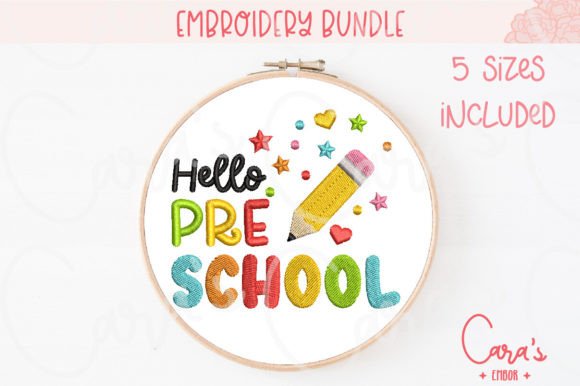
As someone who’s stitched hundreds of Back To School designs for boutique clients, Etsy shops, and custom baby gift lines, I opened Hello Pre School expecting something cheerful — and got exactly that. The layout is open, airy, and intentionally uncluttered: soft rounded letters, a subtle smile embedded in the “o” of “Hello,” and gentle spacing between words. It doesn’t scream “school” with rulers or apples — it whispers “first day jitters, big hugs, and tiny shoes by the door.” That mood is its biggest strength — and its first test.
Real Project Test: A Personalized Tote for a Preschool Teacher
Last week, I used Hello Pre School on a natural cotton canvas tote for a local preschool’s welcome kit. No applique design here — just clean machine embroidery design work in two thread colors (navy and buttercream) on a medium-weight fabric. The result? Instant warmth. Parents smiled when they saw it. Teachers said it felt “thoughtful, not generic.” That tells me Hello Pre School lands emotionally — but only because the stitch execution held up. No skipped satin stitches, no puckering around the curves, and the small “o” smile stayed legible at 3.2 inches wide. That’s not luck. It’s smart digitizing.
Where It Shines — And Where You’ll Want to Pause
Hello Pre School works beautifully on:
- Custom apparel: Sweatshirt embroidery? Yes — especially on midweight fleece where the letterforms read clearly without oversaturation.
- Baby embroidery: On organic cotton onesies or muslin burp cloths, its gentle scale and low stitch density avoid stiffness.
- Tote bag design and kitchen towels: Its horizontal flow fits well across center panels without crowding corners.
- Embroidered patch prep: Clean outlines and minimal underlay mean it presses flat and sews on smoothly.
- Holiday embroidery and wedding gifts for teacher couples: Swap thread colors to sage + cream or blush + charcoal — it adapts without losing identity.
But — and this matters for your craft business — proceed carefully with:
- Thin or stretchy fabric: The letter “l” has narrow verticals. Without proper cutaway stabilizer, those can distort on jersey or rayon blends.
- Dark fabric: The design relies on shape and spacing more than bold contrast. On navy or charcoal, test thread colors first — a matte ecru reads softer than glossy white.
- Curved surfaces like caps: The width stretches the layout. If you’re using it on a front-panel cap, confirm your hoop size allows full-word clearance — no trimming the “e” or “l” mid-stitch.
- Frequent-wash items (like baby blankets): Check stitch density in the file itself. Dense fill stitches hold up; overly tight running stitch borders may fray over time.
What It Adds to Your Handmade Product — Beyond the Thread
Using Hello Pre School isn’t just about putting text on cloth. It adds quiet professionalism. Unlike some Back To School designs that lean cartoonish or overly academic, this one feels intentional — like something a designer chose, not a template dropped in. That builds customer trust. For an Etsy seller listing personalized gifts, that nuance translates directly to perceived value. Buyers don’t pay more for “cute” — they pay more for *considered*.
It also supports brand consistency. Whether you’re stitching nursery decor for a boutique or creating small shop product bundles (think: matching pillow cover + tea towel + embroidered bib), Hello Pre School holds its own without dominating. It doesn’t compete with patterned fabrics — it complements them. And in printable mockups? It renders cleanly in black and white, which matters if you’re prepping digital embroidery file listings or social media previews.
Practical Notes Every Embroidery Designer Should Check
Before stitching your first Hello Pre School project — especially for commercial embroidery or client work — do these five things:
- Test on scrap fabric first, using your exact stabilizer combo and thread brands. Even great digitizing reacts differently to your machine’s tension.
- Review stitch density in your embroidery software. If fill areas look heavy, consider reducing density by 5–8% for lightweight fabrics.
- Confirm hoop size. This design likely fits standard 4×4 or 5×7 hoops — but double-check before hooping expensive garments.
- Inspect small details at 200% zoom: the smile in the “o,” the curve of the “H” leg, the tail of the “y.” Are they smooth? Or does the file rely on excessive jump stitches?
- Verify licensing. Since it’s marketed as a machine embroidery design for multiple uses, confirm whether personal use, small-batch handmade products, or digital resale are permitted — especially if you plan to sell finished items or bundle it into design assets.
Final Thought: Not Just Another Back To School Design
Hello Pre School stands out because it avoids shouting. It doesn’t need clipart icons or forced whimsy to signal its purpose. Its strength is restraint — thoughtful spacing, balanced weight, and a visual rhythm that breathes. That makes it unusually versatile: equally at home on a minimalist linen pillow cover or a vibrant toddler sweatshirt. For craft business owners, Etsy sellers, and designers building recognizable style, that kind of consistency is gold. Just remember — even the friendliest design needs smart prep. Test it. Tune it. Then let it speak softly, clearly, and warmly — exactly as intended.