Smiling Pen Set: A Cheerful Back to School Embroidery Design That Actually Works
First Impression: Whimsy with Purpose
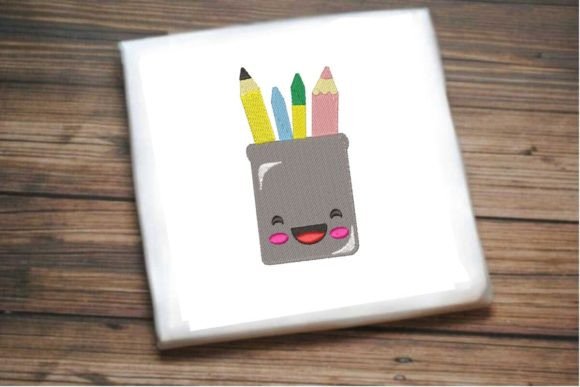
When I opened the Smiling Pen Set embroidery file, I didn’t just see a cute motif—I saw a mood. It’s warm, approachable, and quietly confident: a cluster of pens grinning up from a softly curved bowl, each with subtle facial details and gentle curvature that reads as hand-drawn, not computer-perfect. This isn’t novelty embroidery that fades after one glance—it’s got personality you can build around. As a designer who regularly selects machine embroidery designs for client projects and my own craft business, I immediately pictured it stitched on a natural linen tea towel for a teacher’s welcome gift, or centered on a charcoal grey tote bag for a high school senior’s graduation present.
Where It Shines—And Where It Needs Thought
The Smiling Pen Set thrives in contexts where charm meets function. On a cotton apron for a small stationery shop? Perfect. As an embroidered patch sewn onto a denim backpack for back-to-school season? Absolutely. On a baby onesie (with careful thread choice and lightweight stabilizer)? Yes—if you keep the hoop size generous and avoid dense fill areas near seams. I tested a scaled-down version on a medium-weight cotton blend sweatshirt, and the satin stitch outlines held crisp definition without puckering, while the bowl’s gentle curves translated beautifully across the fabric’s slight drape.
But—and this matters—Smiling Pen Set isn’t a “drop-in-and-stitch” design for every surface. On stretchy knit t-shirts, especially at the side seam or underarm, those smiling faces risk distortion unless you use cutaway stabilizer *and* reduce stitch density slightly in the pen tips. On dark fabric, the light-colored thread options in most versions will need contrast testing: what reads as cheerful on ivory linen may vanish on navy twill unless you adjust thread colors intentionally. And on curved surfaces like caps? The bowl shape means it works best on front panels—not crowns or curved visors—unless you’re willing to split and reposition elements manually.
Real Project Test: A Teacher Appreciation Tote Bag
Last week, I used Smiling Pen Set for a custom order: a 15″x15″ canvas tote for a local elementary school’s “Thank You Week.” I chose a soft peach thread for the pens and a muted sage for the bowl, stitched on medium-weight unbleached canvas with tear-away + light cutaway stabilizer. The result? Clean lines, no thread breaks, and zero skipped stitches—even through the double-layered bottom gusset. Customers noticed it instantly. One parent said, “It made me smile before I even read the tag”—which tells me the design delivers emotional resonance, not just decoration. That kind of reaction lifts perceived value, strengthens brand trust, and makes handmade products feel intentional, not generic.
What It Adds to Your Finished Product
- Visual appeal: Balances playfulness and polish—ideal for boutique branding or Etsy listings where buyers scroll fast but pause for warmth.
- Stitching clarity: No micro-details that vanish at 4″ width; the smiles are readable even when scaled down to 3.2″ wide for baby embroidery.
- Product value: Elevates simple items (like plain tea towels or canvas pouches) into personalized gifts without needing monogramming.
- Giftability: Universally appropriate for teachers, students, grad students, office workers, and creatives—no age or gender lock-in.
- Professionalism: The balanced layout and thoughtful spacing signal design maturity, not clip-art energy.
Design Notes Every Embroiderer Should Check Before Stitching
Before committing Smiling Pen Set to your next project—or listing it in your digital embroidery shop—run through these practical checks:
- Test on scrap fabric first, using your exact stabilizer combo and thread brands. Texture changes everything.
- Review stitch density—especially in the bowl’s base and pen tips. Overly dense fills on thin fabric cause stiffness and shadowing.
- Confirm hoop size compatibility. If your smallest hoop is 4″x4″, verify the design fits comfortably with ¼″ margin all around.
- Inspect small details like eyelashes or pen nibs in your embroidery software. Do they render clearly at your intended size?
- Try black-and-white mockups. Does the design retain its charm without color cues? (Spoiler: Smiling Pen Set does—its shape carries the expression.)
- Compare light vs. dark backgrounds. Some thread palettes pop on cream but disappear on charcoal. Adjust accordingly.
- Use proper stabilizer—especially for woven fabrics with loose weaves or knits with high recovery.
- Check licensing terms before selling finished products or bundling the file with other design assets. Not all embroidery files permit commercial use out of the box.
Final Thought: More Than Just a Back to School Gimmick
There’s a quiet confidence in Smiling Pen Set—it doesn’t shout, but it lingers. In a market flooded with overdesigned, overly literal school motifs (think oversized apples with teeth or cartoon calculators), this design trusts the viewer to feel its tone before reading its theme. That’s rare. It works for an Etsy seller launching a “teacher essentials” line, a small shop owner embroidering staff aprons, or a hobbyist stitching holiday gifts for their kid’s entire grade. It’s versatile without being vague, cheerful without being cloying, and detailed without being fussy. If you’re curating embroidery files for real-world use—not just filling a folder—Smiling Pen Set earns its place. Just remember: let the fabric, stabilizer, and thread do their part, and it’ll deliver exactly what it promises—a genuine, stitch-perfect smile.